Shootings in schools, movie theaters, shopping centers, and elswhere have traumatized the nation. But the face of violence is not just about shootings. Bullying in the schools, domestic violence, elder abuse, sexual abuse and other forms of violence are rampant. More…
Join us this year for a discussion of the question of human dignity and the gospel. So many roads, so much at stake So many dead ends, I’m at the edge of the lake Sometimes I wonder what it’s gonna take To find dignity. Bob Dylan
A small group of children see me taking photos of their school building and scamper to jump in front of the camera. More…
Spiritual Influence: The Hidden Power Behind Leadership by Mel Lawrenz (Zondervan, 2012). Hardcover. 212 Pages. ISBN 978-0310492702
“If you are in a position of positive influence, if you exercise leadership in any way, your faith in God gives you a power—a hidden power—that will allow you to make an enduring difference in the lives of other people and organizations. But how does that power work?” More…
Since influence is all about people, it only makes sense to explore the dynamics of our spiritual influence with other people.
“Circles of Influence” is a simple method anyone can use to take a few weeks and discover how to deepen one’s influence with friends, colleagues, or co-workers. “Circles of Influence” is an excellent team-building exercise. More…
Modeling Perseverance is one of the most powerful forms of spiritual influence.
We don’t seem to use the word perseverance very often. Maybe because it has the word severe in it. Or maybe it seems a bit old-fashioned, like King James Bible English. There is no question that other words roll more easily off the tongue, like winning, succeeding, finishing. But here it is, the biblical mandate: persevere.
The best influencers know how to persevere. Whether or not they know the duration of the effort, the struggles ahead, the distance to the finish line-or even whether there is a finish line—they keep going. One foot in front of the other. Progressing one inch at a time. Each day a new opportunity to start again. People who persevere hold to a conviction that plodding ahead pleases God, even when there is no applause and no immediate reward. Continue Reading…
This post was written by Mel Lawrenz on Tuesday, May 14th, 2013 and is filed in Posts.
[I have given copies of this to many leaders, and have had leadership groups listen to the audio in groups. This is a seminal address. Every Christian leader should read this!]
John Stott Address at Keswick
Dr. John Stott – ‘The model – becoming more like Christ.’ Sermon delivered at the Keswick Convention July 17th 2007.
I remember very vividly, some years ago, that the question which perplexed me as a younger Christian (and some of my friends as well) was this: what is God’s purpose for His people? Continue Reading…
One large truth keeps dropping in front of my face ever since the death of philosopher and author Dallas Willard last week.
I’ve read numerous tributes by friends and associates of Willard’s and they keep bringing up this one large truth. I had just one conversation with Dallas Willard years ago, but it confirmed to me that he was driven by this one large truth. Many of my friends who have promoted spiritual formation in the last twenty years have also been speaking about this one large truth since Willard’s death.
John Stott spoke about this one large truth in his last public address given in the summer of 2007, saying that this truth is the sum of the Christian life. Continue Reading…
Psalm 25 says “they will be put to shame who are treacherous without excuse.” In the aftermath of the terrorist bombing in Boston, we may pray other words from the same psalm: “To you, O LORD, I lift up my soul; in you I trust, O my God. Do not let me be put to shame, nor let my enemies triumph over me.”
To you, O LORD, I lift up my soul; in you I trust, O my God. Do not let me be put to shame, nor let my enemies triumph over me. No one whose hope is in you will ever be put to shame, but they will be put to shame who are treacherous without excuse.
Once again the unthinkable has happened. Yet this is the way we now think of the world since 9/11. Another beautiful day ripped apart by explosions that tore the lives of innocent bystanders. Unthinkable. Shameful. Treacherous.
There is a word for this: treachery. But what do you do on the other side of the terrorist’s attack? What can we say in the face of pure treachery? Continue Reading…
This post was written by Mel Lawrenz on Saturday, March 30th, 2013 and is filed in Devotionals.
Later, Joseph of Arimathea asked Pilate for the body of Jesus. Now Joseph was a disciple of Jesus, but secretly because he feared the Jews. With Pilate’s permission, he came and took the body away. He was accompanied by Nicodemus, the man who earlier had visited Jesus at night. Nicodemus brought a mixture of myrrh and aloes, about seventy-five pounds. Taking Jesus’ body, the two of them wrapped it, with the spices, in strips of linen. This was in accordance with Jewish burial customs. At the place where Jesus was crucified, there was a garden, and in the garden a new tomb, in which no one had ever been laid. Because it was the Jewish day of Preparation and since the tomb was nearby, they laid Jesus there. (John 19:38-42)
A small act of mercy on the part of Joseph of Arimathea meant that Jesus’ limp and lifeless body would not be thrown into a pit of a grave, but laid carefully in a rock-hewn garden tomb. Joseph was probably a man with significant conflicts. Wealthy, a prominent member of the Jewish council, he represented the very establishment that was committed to Jesus’ demise. Yet he believed in Jesus, secretly. To believe in Jesus does put one on the spot. Being a committed disciple of Jesus always upsets the status quo.
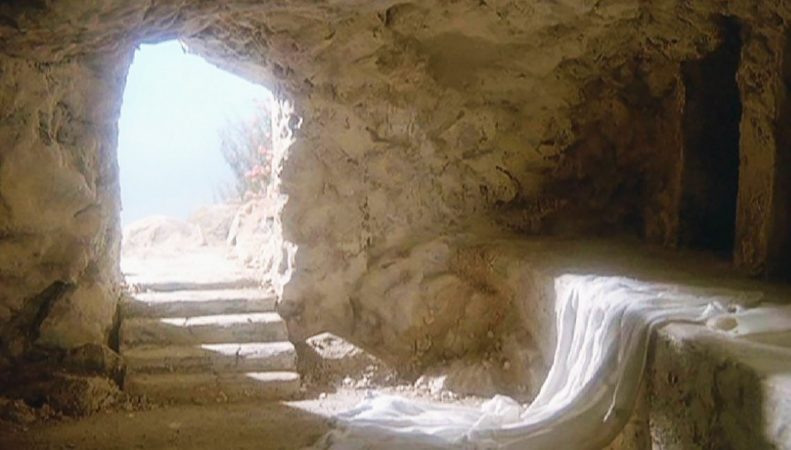
Nicodemus, also fearful but compelled, came to the tomb too. So there two men, both of whose associations put them at odds with Jesus, both of whom really wanted to believe, are the ones who respectfully wrap the body of Jesus in cloths and seventy-five pounds of spices. Yet the only thing that can really take away the stench of death and its empty stare is resurrection.
These and the other disciples were still stuck in that no-man’s-land between life and death. All that Jesus’ followers had to hold onto were Jesus’ vague words about rising from death. Could such words be taken seriously at all? What would they do in these days? Would they be arrested next? And so they waited behind locked doors because there was nothing else to do.
Many of us feel like we are stuck waiting in life. Waiting after a hard thing that has happened. Waiting to see if there really is hope. Waiting for the power of God.
Ponder This: Is there some way in which you are waiting to see what will happen next? How will you find faith in the waiting place?
This post was written by Mel Lawrenz on Friday, March 29th, 2013 and is filed in Devotionals.
They came to a place called Golgotha (which means The Place of the Skull). There they offered Jesus wine to drink, mixed with gall; but after tasting it, he refused to drink it. When they had crucified him, they divided up his clothes by casting lots. And sitting down, they kept watch over him there. Above his head they placed the written charge against him: THIS IS JESUS, THE KING OF THE JEWS (Matthew 27:33-37).
Now came time for the clash between good and evil, heaven and hell. The crucifixion of Jesus is both the most horrific moment in human history and humanity’s only hope. That’s why we call the Friday before Easter Good Friday. Continue Reading…
This post was written by Mel Lawrenz on Thursday, March 28th, 2013 and is filed in Devotionals.
Jesus said, “Now is the Son of Man glorified and God is glorified in him. If God is glorified in him, God will glorify the Son in himself, and will glorify him at once. My children, I will be with you only a little longer. You will look for me, and just as I told the Jews, so I tell you now: Where I am going, you cannot come. A new command I give you: Love one another. As I have loved you, so you must love one another. By this all men will know that you are my disciples, if you love one another.” (John 13:31-35)
The word “Maundy” comes from the Latin word for commandment (mandatum), which Jesus talked about when he told his disciples that he was leaving them “a new commandment,” that they “love one another.” There were probably so many things going on in the disciples’ minds in that upper room where they had their last supper together, including fear and bewilderment from Jesus telling them that someone in that very room would betray him. Continue Reading…
Announcing… a new initiative this year, which we are calling “In Search of Dignity.”
I’d like to tell you about a new initiative this year, which we are calling “In Search of Dignity.” I have come to believe that dignity, and its opposite, indignity, sum up the heights and the depths of what our lives can be.
Dignity means worth or value. It is what God intended when he created humanity. It is what the careless and cruel deeds of humanity spoil but cannot destroy. Continue Reading…
This post was written by Mel Lawrenz on Thursday, February 14th, 2013 and is filed in Featured.
Shootings in schools, movie theaters, shopping centers, and elswhere have traumatized the nation. But the face of violence is not just about shootings. Bullying in the schools, domestic violence, elder abuse, sexual abuse and other forms of violence are rampant. Continue Reading…
This post was written by Mel Lawrenz on Thursday, February 14th, 2013 and is filed in Featured.
Join us this year for a discussion of the question of human dignity and the gospel. So many roads, so much at stake So many dead ends, I’m at the edge of the lake Sometimes I wonder what it’s gonna take To find dignity. Bob Dylan
A small group of children see me taking photos of their school building and scamper to jump in front of the camera. Continue Reading…
Here is where faith begins. “I believe in God the Father almighty, creator…” You are not an accident. You are not merely the best mutation in the neighborhood. You are not merely a species who is really good at avoiding getting eaten by another species. You can seek design and purpose in your life because you were created according to a design. And a “very good” one at that. Continue Reading…
What do you really see when you look in the mirror? You probably notice the lines that were not there a year ago. The scar just beneath your chin from when you went head-first over your bicycle when you were a kid and they stitched you up with little thought to “cosmetic” effect. Your eye is drawn to your retreating hairline or your sagging skin. Your eyes have seen the pleasing and the ugly. You may even look at your face in the mirror and wonder, as we all do, is that really who I am? Not because of the flaws, but because you know that your soul is too big to be circumscribed in a face.
This post was written by Mel Lawrenz on Tuesday, January 1st, 2013 and is filed in Devotionals.
In many doorways of the Roman Empire there was a depiction of a god with two faces pointing in opposite directions. Janus was the god of transitions. He looked ahead and he looked behind–to the past and the future. He was a kind of doorkeeper, a minder of the gate. And so our calendar’s first month, January, is named after him. On January 1 of the new year we look behind, and we look ahead.
So what’s on the other side of the doorway you’re stepping through? Continue Reading…
Message (“Words of Encouragement”) given by Pastor Stuart Briscoe at the Memorial Service for Jennifer Sebena, December 29, 2012 at Elmbrook Church.
[Jennifer Sebena was gunned down while on patrol in the early morning hours of Christmas Eve, 2012.]
It was Christmas Eve in Wauwatosa. In the early hours of the morning. Most of the citizens were asleep in their beds, warm, comfortable, safe. The Wauwatosa Police Department was on the job patrolling and protecting. A solitary squad car made its way on quiet streets past the Christmas lights and the Santa signs, a lone officer at the wheel. Jennifer Sebena, 30 years of age, two years on the force had wanted to be a cop for as long as she could remember and when she set her mind to something she pursued it with diligence. No surprise she graduated top of her class at the academy. She was on patrol.
Jennifer was suffering under no illusions when she buckled on her bullet proof vest that night. She knew the Wauwatosa Police Department had not lost an officer on duty in their 96-year history, but she also knew that the streets in the early morning hours are not the safest places in the world. Like all her fellow officers she knew that putting on the uniform was a passport to harm’s way.
This post was written by Mel Lawrenz on Tuesday, December 25th, 2012 and is filed in Christmas Joy.
After Christmas, new articles in The Brook Letter by Mel Lawrenz: sign up.
The shepherds returned, glorifying and praising God for all the things they had heard and seen, which were just as they had been told. -Luke 2:20
At the birth of Jesus, amidst the dirt and straw of a stable, millennia of promises, prophecies, and hopes were fulfilled. In the birth of a child, something that happens every single day all over the world, something happened that would change the world. Everything the faithful were anticipating took shape. It was the alignment of all that was meant to be. But the birth of Jesus has that power and significance only if he really is who he said he was.
This post was written by Mel Lawrenz on Monday, December 24th, 2012 and is filed in Posts.
On December 24, 1968, three astronauts gave a Christmas greeting to more people on earth who had ever listened to a broadcast in history, as they orbited the moon. Here are their exact words:
Bill Anders
“We are now approaching lunar sunrise and, for all the people back on Earth, the crew of Apollo 8 has a message that we would like to send to you.
In the beginning God created the heavens and the earth.
And the earth was without form, and void; and darkness was upon the face of the deep.
While they were there, the time came for the baby to be born. – Luke 2:6
On the night before Jesus was born, the shepherds would have seen the night sky the way they had seen it thousands of times before. That was a quiet night, in stark contrast to the following night, when an angel would appear with “the glory of the Lord,” announcing the birth of the child—then join with a great company of heavenly beings proclaiming glory and peace. Continue Reading…
That which was from the beginning, which we have heard, which we have seen with our eyes, which we have looked at and our hands have touched—this we proclaim concerning the Word of life. The life appeared; we have seen it and testify to it, and we proclaim to you the eternal life, which was with the Father and has appeared to us. – 1 John 1:1-2
Beginning. The Beginning. How much we all want to know about the beginning of all things, in order to understand the now of all things, and to pursue the way things are supposed to be in our lives today. The original design must be the ideal, the way things ought to be. The Bible’s opening words: “In the beginning, God created the heavens and the earth,” delineate between a time in which there was only God, and a new time in which his magnificent creation began (Gen. 1:1).
This post was written by Mel Lawrenz on Saturday, December 22nd, 2012 and is filed in Christmas Joy.
After Christmas, new articles in The Brook Letter by Mel Lawrenz: sign up.
For my eyes have seen your salvation, which you have prepared in the sight of all people, a light for revelation to the Gentiles and for glory to your people Israel. – Luke 2:30-32
The winter solstice on December 21, the darkest day of the year, means for many of us who live halfway between the equator and the North Pole, that we have breakfast when it is still dark outside, and that by supper, the sun has long set. That slide toward the shortest day of the year seems like sinking into a black hole. No wonder people in ancient cultures celebrated the days when the sun began to return. The prophet Malachi spoke of the healing power of light: “The sun of righteousness will rise with healing in its wings” (Malachi 4:2).
The word became flesh, and made his dwelling among us. – John 1:14
Not only did the Son of God become a baby, but also he became flesh. Divinity joined to corporeal muscle, blood and bones. In this humbling of the eternal Son of God, the Word who was with God from the beginning and was God, chose to begin in the way all flesh does—as a newborn.
But what does “flesh” really mean? Doesn’t it sound a bit crass?
They went on their way, and the star they had seen in the east went ahead of them until it stopped over the place where the child was. When they saw the star, they were overjoyed. – Matthew 2:9-10
In Psalm 19, David gives voice to the stars:
The heavens declare the glory of God; the skies proclaim the work of his hands. Day after day they pour forth speech; night after night they display knowledge. There is no speech or language where their voice is not heard. Their voice goes out into all the earth, their words to the ends of the world. (Vss. 1-4)
If you have ever stood outside at night and looked up at the canopy of stars, away from the city, away from noise, you may have seen that the stars have a message. In silence they speak, and their voice is thunderous.
This post was written by Mel Lawrenz on Wednesday, December 19th, 2012 and is filed in Christmas Joy.
After Christmas, new articles in The Brook Letter by Mel Lawrenz: sign up.
After Jesus was born in Bethlehem in Judea, during the time of King Herod, Magi from the east came to Jerusalem and asked, “Where is the one who has been born king of the Jews? We saw his star in the east and have come to worship him.” – Matt. 2:1-2
Mary and Joseph stayed in Bethlehem many months after the birth of Jesus, yet we know nothing about that time. How was Mary treating her baby, knowing she would have to submit to him as her Lord? How much attention were they getting from the townspeople? What were they telling people, if anything? We simply don’t know. But we do know that one day some travelers from the east—maybe Persia or Mesopotamia (the regions of modern day Iran or Iraq)—suddenly showed up in Bethlehem, claiming to have been guided to a new king by a star.
And he will be called…Prince of Peace – Isaiah 9:6
In ancient times, princes, whether they desired it or not, often became warriors. Rulers of nations may talk about peace, but nothing is more elusive than peace. And so, when Isaiah talked about a child who would be born, a son who would be given, who would be called “Prince of Peace,” it sounded like high rhetoric, wishful thinking. Could it ever possibly happen?
And he will be called…Everlasting Father. -Isaiah 9:6
What a remarkable string of names in Isaiah 9:6! Wonderful Counselor, Mighty God, Everlasting Father, Prince of Peace.
Now, these were radical statements indeed, and they described the one who was coming to rule heaven and earth. A coming ruler might—if he were an ordinary ruler—simply assert his authority and prerogatives as sovereign. As we well know, a king is one who has the power because he has an army, and who has wealth because he controls the resources of his realm. That is the way of earthly rulers. But Isaiah also spoke of a ruler whom people would look to in far more personal terms: “Father.”
In the Old Testament, some of the prophecies about Christ are mysterious statements. They were so bold and so large that they were treasured through the generations, until they were fulfilled and finally understood. Isaiah’s oracle about a son who would be born—Wonderful Counselor, Prince of Peace, and all the rest—was one of those landmark prophecies. In that moment of inspiration, Isaiah revealed he would be Mighty God.
And I asked “why, why, why, oh God? Why did it have to be only my sister who was killed on the patrol that day?” -20-year-old female American soldier speaking at her twin sister’s funeral.
It is the mystery that always seems to move further from our reach the more we reach out for an answer. The issue you bristle at hearing. The question you can’t help but ask.
Why do bad things happen to innocent people?
Years ago I would have responded to this question differently than I do today. Like most questions, I assumed this one was a blank needing to be filled in, a query looking for the most biblical and reasonable solution that can be offered. And while that is partly true, it is obvious that for many who voice these words, it is not a question at all. It is a cry of anguish. It is the way people say, “I am hurting so badly, and I just don’t understand it.” No matter what “answer” someone gives to the problems of pain and evil, suffering people are still left with the gap of what or whom they have lost. Answers don’t replace people. The question is not one of philosophy, but of personal need: “Why, oh why, does this have to be?” Or, as the Psalms so often say, “How long, O Lord?”
Crisis opens us like an earthquake cracking the crust of the earth. A crisis is a time to decide, a turning point. Crisis moments require spiritual responsiveness and open a whole new opportunity for sustained spiritual influence. Crisis is where we learn about our base instincts, because people’s hearts are torn open, what is inside comes out, and new truths and values may enter in.
Of all the formative influences in people’s spiritual lives, the experience that is the most influential is crisis. People never forget a heartrending, danger-ridden passage—a true crisis—and what they learned about faith during and after that time. The most deforming experiences in life often turn out to be the most formative.
The Ministry of Presence
Time and again in the Scriptures, what God says in times of crisis is: I am here. I will not abandon you. You are not alone. Continue Reading…
For to us a child is born, to us a son is given, and the government will be on his shoulders…and of the increase of his government and peace there will be no end. He will reign on David’s throne and over his kingdom, establishing and upholding it with justice and righteousness from that time on and forever. – Isaiah 9:6-7
Government. Does that word strike a positive note in you, or negative note? The word has good and bad connotations. Over the centuries, many corrupt governments run by greedy and power-hungry people have imposed tyranny rather than justice. Their form of order is more often a form of chaos.
This post was written by Mel Lawrenz on Friday, December 14th, 2012 and is filed in Real Life.
As I sit in an airport watching on television the unfolding horrific story of the shooting at the school in Connecticut, I overheard an airport worker say to someone else: all those children, all those families–and now, at Christmas time.
Immediately what came to my mind was one of the most troubling Scripture verses associated with Bethlehem. That awful, horrible, unspeakable crime of a megalomanic named Herod who had all the boy babies in Bethlehem murdered just so that he could eliminate the one whom people were calling a newborn king.
How can a man do that? How can a man try to assassinate the Messiah?
This post was written by Mel Lawrenz on Friday, December 14th, 2012 and is filed in Christmas Joy.
This is post #14 in the Christmas devotional “Christmas Joy.” Past days HERE.
Mel Lawrenz is Minister at Large for Elmbrook Church and directs The Brook Network.
For to us a child is born, to us a son is given, and the government will be on his shoulders. And he will be called Wonderful Counselor, Mighty God, Everlasting Father, Prince of Peace. -Isaiah 9:6
“What is the baby’s name?” The people in Bethlehem who had heard of a baby born in a stable must have stopped by to talk to Mary or Joseph. Mary and Joseph voiced the name they themselves had not chosen: Jesus. But hundreds of years earlier, other names had already been announced for the Anointed One. Among them, Isaiah spoke of one who would be called Wonderful Counselor.
This post was written by Mel Lawrenz on Thursday, December 13th, 2012 and is filed in Christmas Joy.
This is post #13 in the Christmas devotional “Christmas Joy.”
After Christmas, new articles in The Brook Letter by Mel Lawrenz: sign up.
My soul magnifies the Lord and my spirit rejoices in God my Savior. -Luke 2:46-47
One of the worst things that can happen to a person is to live with a shrunken understanding of God, a shrunken soul. This is the perfect reason to take Christmas seriously, as our best hope for our minds and hearts to be enlarged with God’s greatness.
Mary’s response to the message that she would bear the savior was a remarkable song of praise, sometimes known as the Magnificat (Luke 2:46-55). It begins, “My soul magnifies the Lord,” which means that because God’s announcement opened her heart him in a way that she couldn’t have imagined, her soul was beginning to grasp the bigness of God.
I remember the first time I looked through a telescope at the open sky on a cold winter evening. When I pointed it at the half-lit moon, I was stunned as it came into focus—to see mountains and plains, unlike the picture books I was used to, but the real thing in real time. An ethereal, bright disk hanging in the sky was now a real place to me. The telescope magnified its reality. The moon didn’t increase, but my comprehension of it did.
Sometimes human beings look at God as if he were a distant point of light. But when we take his word into consideration, and if we accept it by faith, our perspective changes drastically. We see that we are living in a greater reality, with a greater God than we had imagined, and with greater possibilities in our future.
Mary knew her life would never be the same—not just her life, but the lives of countless others—because of what God was going to do. This stretched her soul, and it can stretch ours.
Prayer for today:
Lord, this Christmas, give me a larger vision of who you are. May you be magnified in my soul, and may others see that you are the focus of my celebration.
All this took place to fulfill what the Lord had said through the prophet: “The virgin will be with child and will give birth to a son, and they will call him Immanuel”—which means, “God with us.” -Matt. 1:22-23
My wife and I have only seriously lost track of our daughter once. We were walking through a crowded tourist town and the streets were lined with shops. It was evening and the crowds were dense. Suddenly, I noticed that neither my wife nor I had our eight-year-old daughter by the hand. We spun around, unable to spot her. With candy stores beckoning children indoors, and winding side streets all around, she could be anywhere.
This post was written by Mel Lawrenz on Tuesday, December 11th, 2012 and is filed in Christmas Joy.
This is post #11 in the Christmas devotional “Christmas Joy.” Past days HERE. “Christmas Joy” as eBook HERE.
So Joseph also went up from the town of Nazareth in Galilee to Judea, to Bethlehem the town of David, because he belonged to the house and line of David. -Luke 2:4
Bethlehem was like any other town in the hills of Judea. Yet, it was the birthplace of the greatest king of Israel, David, and one thousand years later, the Messiah.
How does such honor come to the ordinary? Were the people of this town particularly worthy? Was there some great strategic advantage to where it lay? Were the people of Bethlehem politically savvy, having a long history of producing great leaders? Not at all. The little town of Bethlehem was in the shadow of great Jerusalem just six miles to the north. Even the meaning of Bethlehem, “house of bread,” is unremarkable.
This post was written by Mel Lawrenz on Monday, December 10th, 2012 and is filed in Christmas Joy.
Mel Lawrenz is Minister at Large at Elmbrook Church and directs The Brook Network.
Today in the town of David a Savior has been born to you; he is Christ the Lord. -Luke 2:11
Some people think that “Christ” is Jesus’ last name. Jesus Christ, like Joe Johnson or Audrey Smith. If you have thought that, don’t feel bad. It is just evidence that over the centuries our understanding of Jesus as the Christ has become so solid in our thinking that we don’t think of “Jesus” without “Christ.”
She will give birth to a son, and you are to give him the name Jesus, because he will save his people from their sins. – Luke 2:7
Sometimes a name is just a name, and sometimes a name captures someone perfectly. The ancients inclined to choose names carefully, so as to make a lifelong statement about a person’s identity. “Jesus” is a name so familiar to us, that we easily forget that it was a name with an extraordinary significance. The name an angel announced should be given to Mary and Joseph’s new child. And what a name! “Jesus” means “the Lord saves.”
Where is the first place a baby is placed after it emerges from the mother’s womb? Today we use hyper-sterilized blankets and sanitized cribs. A Plexiglas dome, if necessary. All precautions go toward minimizing the germs the child may come into contact with.
But Mary laid Jesus in the feeding trough for an animal. The Good Shepherd took refuge that night in the sheep’s manger, and when the shepherds came to see what was announced to them, how stunned they must have been.
This post was written by Mel Lawrenz on Friday, December 7th, 2012 and is filed in Christmas Joy.
This is post #7 in the Christmas devotional “Christmas Joy.” Previous days HERE. Christmas Joy as Kindle book HERE.
He will be great and will be called the Son of the Most High. The Lord God will give him the throne of his father David, and he will reign over the house of Jacob forever; his kingdom will never end. -Luke 1:32-33
Christmas represents a beginning that only makes sense if we comprehend the end. The beginning is a child—a humble birth in an earthy stable. But the end… The end is an explosion of divine glory bright enough for the whole world to see—like the birth of new star. The end is a kingdom. Jesus came to forward the kingdom of God, to open people’s eyes to the power of God, to make it the central reality of their lives. “His kingdom will never end.”
This is how the birth of Jesus Christ came about: His mother Mary was pledged to be married to Joseph, but before they came together, she was found to be with child through the Holy Spirit. Because Joseph her husband was a righteous man and did not want to expose her to public disgrace, he had in mind to divorce her quietly. -Matthew 1:18-19
We know so little about Joseph. He is only mentioned in the birth and childhood stories of Jesus. He was named after an ancient patriarch who used his success in Egypt to save his family and a future nation. Joseph was a carpenter who lived in the town of Nazareth. His ancestors were from Bethlehem, so when a Roman ruler, Caesar Augustus, wanted a census, Joseph had to go back to Bethlehem, even though his wife was well along in her pregnancy.
And there were shepherds living out in the fields nearby keeping watch over their flocks at night. – Luke 2:8
It may seem like a stretch of the imagination, but try it anyway: If you were God, and could announce the arrival of the savior of humanity, would you send your messengers to some shepherds out in the fields, as they whiled away their nighttime watch? Why not instead send angels to an assembly of the religious council in Jerusalem? Why not to the megalomaniac King Herod? How about Caesar? Wouldn’t that be a night of work—to blow opens the doorways of society, to change everything with a few simple words.